An Enterprise Phone-Agent Evaluation Brief Before a Demo
A productive evaluation starts with your own operating requirements, not a vendor's feature list. Give each stakeholder the same caller scenarios, decision criteria, and open questions before comparing options.
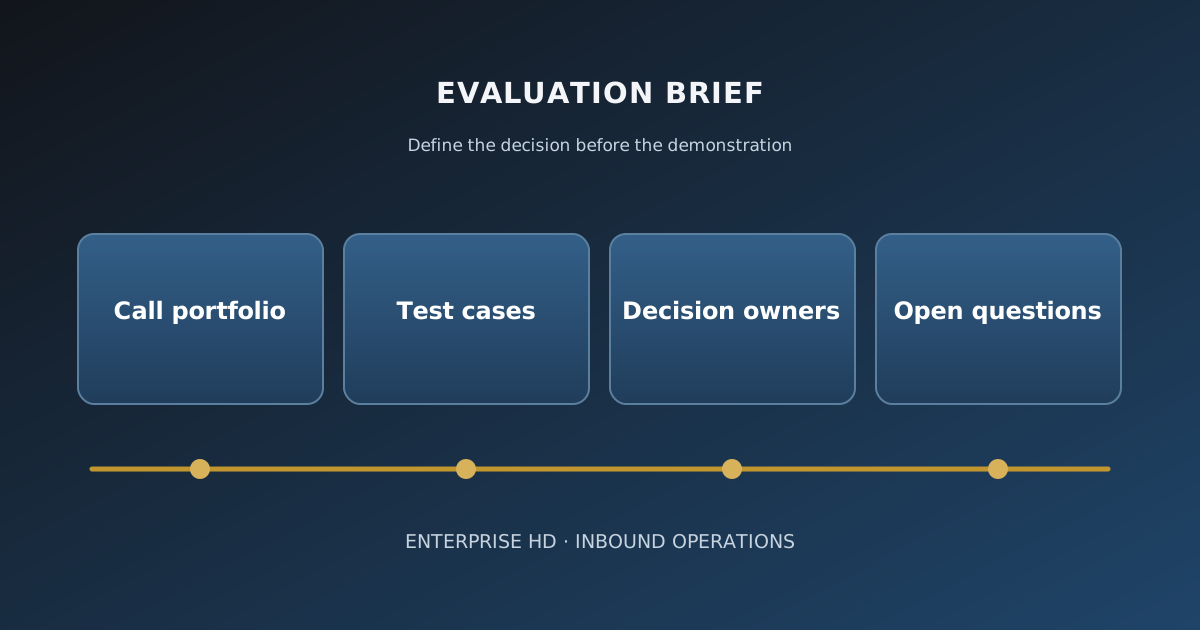
An enterprise inbound line is shared by callers, departments, and the people responsible for exceptions. A convincing demonstration is not enough to decide whether a phone-agent approach fits that environment. Before a briefing, write a short evaluation brief that describes the calls you actually receive and the decisions your team needs to make. That gives operations, department leads, and technical reviewers a common basis for comparison.
Start with the call portfolio, not a feature wish list
List the lines and departments in scope, the reason people call each one, normal and after-hours coverage, and a rough volume range if your team has it. Separate routine information requests from calls that need a person to make a judgment. Do not assume every line should share one flow.
For each call type, record who owns the next action, what information that person needs, and what happens if the first destination is unavailable. Our multi-team routing checklist can help structure that internal inventory. The evaluation brief is different: it turns the inventory into a set of questions for comparing a proposed service.
Use the same test cases with every option
Choose a few representative scenarios from your own operations. A useful set might include a straightforward department request, a request with two possible owners, an after-hours exception, and a caller who cannot provide a required detail. Write the expected next action for each scenario before anyone sees a demo. This helps prevent a polished but irrelevant demonstration from setting the criteria.
- Caller context: What should be captured before a handoff, and which details should never be requested on this line?
- Destination: Which team is authorized to receive this type of request, and what is the fallback if no one is available?
- Exception: Which cases require a human decision rather than a confident-sounding automated answer?
- Review: How will your team decide whether the observed outcome matched its own rule?
These are buyer-side test prompts, not a claim that a particular demo, test environment, or integration is included in an Enterprise HD service. Ask what can actually be shown and verified for your proposed scope.
Assign decision owners before the briefing
One attendee rarely owns every consequence of inbound call handling. Identify a business owner for the desired caller outcome, an operations owner for routing and staffing, a receiving-team owner for handoff quality, and the appropriate internal reviewer for data handling or technical fit. One person may hold more than one role, but each decision needs a named owner.
Give those owners a simple decision sheet: requirement, scenario, reviewer, evidence observed, and unresolved question. Mark an item unverified when it has only been described, not demonstrated or documented. A question about data retention, access controls, integrations, uptime, or support should stay a question until the provider supplies applicable details; do not infer it from general marketing copy.
Leave with a decision, not just impressions
After the discussion, classify each requirement as supported by evidence, needs a scoped answer, or outside the current fit. Name the person responsible for every open item and the evidence needed to resolve it. If your team is ready to discuss the call path itself, use our overview of how Enterprise HD approaches inbound workflows as a starting point, then request a briefing with your call portfolio and evaluation questions.
The useful result is not a universal score. It is a defensible decision about whether the proposed approach fits your lines, your teams, and your exception boundaries.