What Should Change When an Enterprise Call Route Changes?
When an enterprise call route changes, updating the routing logic is only half the work. Operations leaders must align receiving departments, verify escalation owners, and audit exception paths before modifying live call traffic.
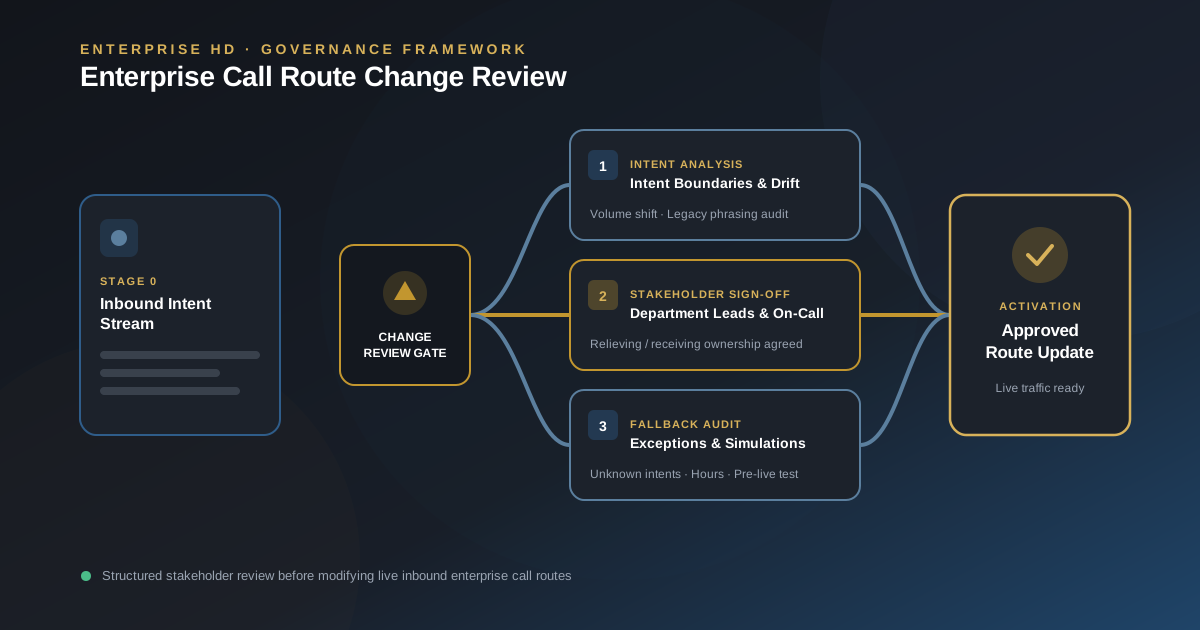
In a high-volume enterprise operation, updating an inbound call route is rarely as simple as pointing a phone number to a different queue or updating a prompt in a configuration console. When thousands of callers reach an organization each week across multiple divisions, service lines, and geographic markets, a routing change is an operational event that ripples across the entire organization.
If a route change is treated purely as a technical adjustment, small misalignments quickly create operational friction:
- Receiving departments are blindsided by unexpected call types they are neither staffed nor trained to handle.
- Secondary caller questions get caught in transfer loops because adjacent teams were not consulted.
- High-priority escalation moments stall because the receiving team assumed someone else owned the fallback path.
To prevent disruption to live operations, an inbound operations owner must lead a disciplined cross-departmental review before any changes are applied to active call traffic.
A successful enterprise call route review answers three fundamental operational questions:
- Which caller intents are affected by the proposed change?
- Which departments and escalation owners must evaluate and sign off on the revision?
- What operational exceptions and fallback paths must be validated before staff treat the new route as current?
Here is a practical framework for coordinating department stakeholders, auditing operational dependencies, and validating an enterprise route update before putting it into production.
1. Identify which caller intents are affected by the proposed change
The first step in any route change is establishing precisely what is shifting from the caller's perspective. Organizations frequently make the mistake of defining changes using internal organizational charts—such as “moving Tier 2 Commercial Support under Operations.” However, inbound callers do not navigate organizational charts; they call with specific problems, urgent questions, and distinct intents.
When planning a route modification, map the change against four caller intent dimensions:
Boundary changes between related intents
When a route is modified, the criteria that separate one intent from another often shift. For instance, if an organization decides that “billing inquiries” over a certain contract threshold should route directly to Dedicated Account Management rather than General Accounts Receivable, the operations owner must explicitly define:
- How does the intake flow distinguish a standard invoice question from a major contract dispute?
- What specific phrasing or account criteria trigger the diversion?
- Will callers with compound inquiries—such as a service disruption paired with a billing question—be routed to the technical team or the commercial team first?
As detailed in our guide on designing a policy-aware enterprise call route, routing decisions must be anchored in repeatable operational rules rather than ambiguous departmental titles.
Diverted or displaced call volume
Every routing change redistributes call traffic. If an intake prompt is adjusted to divert contract renewal calls away from general customer service, where will those calls land, and what is the expected volume shift?
- Does the receiving department have the staffing capacity to absorb the newly directed volume?
- If the receiving team is overwhelmed during peak hours, does the overflow route return to the original department, or does it follow a designated escalation queue?
- Are the diverted calls concentrated in specific hours or time zones that require adjusted coverage schedules?
Failing to estimate the volume impact across receiving queues is one of the most common causes of department friction following a route modification.
Phrasing drift and caller vocabulary
Internal teams frequently update their product terminology, service tiers, or brand names, but callers continue using legacy terminology for months or years.
- Does the proposed route change account for the historical terms callers still use when describing their issue?
- If a legacy service has been retired or merged into a new division, does the route recognize the old name and direct the caller to the successor team?
- Is the intake flow structured to ask clarifying questions when a caller's stated reason could apply to multiple departments?
As outlined in when an enterprise call route needs more than a department name, effective enterprise intake relies on understanding the context behind the caller's request, not merely matching keywords against current department labels.
Unaffected baseline intents
Equally important is verifying which intents should not change. When reconfiguring routing logic, operations teams must confirm that baseline paths—such as urgent safety reporting, general headquarters operator routing, or existing vendor inquiries—remain completely undisturbed. A focused intent audit prevents unintended collateral changes to high-volume standard paths.
2. Coordinate department stakeholders and escalation owners
An inbound operations owner does not operate in a vacuum. A call route is a shared service agreement between the front-line answering mechanism and the operational teams who resolve caller inquiries. Before any change is scheduled for production, the operations owner must assemble the affected department leads and establish explicit ownership.
+-----------------------------------------------------------------------------+
|               ENTERPRISE ROUTE CHANGE STAKEHOLDER COORDINATION              |
+-----------------------------------------------------------------------------+
|                                                                             |
|   [ Inbound Operations Owner ]                                              |
|      Coordinates change scope, timeline, and validation walkthrough         |
|                 │                                                           |
|                 ├──> [ Relieving Department Lead ]                          |
|                 │       Confirms which calls will no longer be received;    |
|                 │       verifies re-routing criteria and residual flows     |
|                 │                                                           |
|                 ├──> [ Receiving Department Lead ]                          |
|                 │       Approves new intake criteria, staffing capacity,    |
|                 │       and required context fields                         |
|                 │                                                           |
|                 └──> [ Escalation & On-Call Owner ]                         |
|                         Accepts explicit accountability for unresolvable    |
|                         calls, threshold breaches, and urgent exceptions    |
|                                                                             |
+-----------------------------------------------------------------------------+
The relieving department lead
The team currently handling the call volume must confirm the change.
- Do they agree on which calls are being removed from their queues?
- Have they reviewed how residual inquiries (calls that touch both the old and new scopes) will be handled if they reach their staff?
- Have their internal knowledge bases, desktop scripts, and transfer menus been updated to prevent staff from immediately bouncing callers back to the old route?
The receiving department lead
The team taking on the new or modified call flow must validate the intake parameters.
- Have they reviewed and approved the specific intake questions used to qualify callers before the transfer occurs?
- As examined in what an enterprise inbound intake record should include, does the intake process gather the exact operational data fields their agents need to immediately assist the caller?
- Has the receiving team confirmed that their telephony hunt groups, queue priorities, and business hours match the proposed route schedule?
The designated escalation owner
Every enterprise route change must identify an explicit human escalation owner.
- Who receives a caller whose situation exceeds standard triage rules or requires urgent managerial intervention?
- Is the escalation path directed to a named role (e.g., “Operations Duty Manager” or “Tier 3 Escalation Lead”) rather than an unmonitored shared mailbox or generic distribution queue?
- Has that escalation owner reviewed the threshold conditions under which they will be contacted, including warm-transfer protocols and after-hours paging expectations?
Routing changes should never proceed under implicit or assumed ownership. Every receiving lead and escalation owner must formally review and sign off on their operational responsibilities before the route is activated.
3. Audit exceptions and fallbacks before live activation
The true test of an enterprise call route is not how it performs during ideal conditions, but how it behaves when conditions break down. Before treating any new route as current, the operations owner must conduct a rigorous pre-activation audit of every exception and fallback mechanism.
The “caller does not know” exception
Callers frequently reach an enterprise line without knowing which department they need, or their issue may span multiple business units.
- If a caller cannot answer initial qualification questions or gives contradictory responses, what is the default routing rule?
- Does the system provide a graceful path to a human generalist or operator rather than looping or abruptly disconnecting?
- Does the intake record preserve whatever preliminary context was gathered so the human receptionist does not force the caller to start over from scratch?
Destination unavailable and concurrency limits
What happens when the primary receiving destination is unable to accept the call?
- If the receiving department's queue reaches maximum capacity, all lines are busy, or an unexpected outage occurs, where does the call divert?
- Is there a secondary receiving team, an on-call manager, or a structured callback mechanism?
- Does the fallback route prevent infinite circular transfers between departments that are both experiencing high volume?
Operating hours and holiday exceptions
Enterprise departments rarely operate on identical schedules. A central sales team may operate from 8:00 AM to 8:00 PM Eastern, while specialized engineering support operates 24/7, and accounting closes at 5:00 PM Central.
- When a route is changed, have the operating schedules and time-zone boundaries been re-verified for every leg of the transfer?
- What happens when an inbound call qualifies for a department that is currently closed? Does the route offer after-hours intake, an emergency on-call transfer, or scheduled callback options?
- Have scheduled corporate holidays and planned maintenance windows been synchronized across the revised route?
Pre-activation verification walkthrough
Never activate an enterprise route change based solely on documentation. Conduct a structured pre-activation walkthrough:
- Simulate happy-path calls: Place test calls representing standard inquiries to verify that prompt phrasing, qualification rules, and transfer destinations connect correctly.
- Simulate edge cases and ambiguous requests: Place test calls using conflicting information, legacy product names, and incomplete answers to ensure exception routing triggers as designed.
- Simulate unavailable destinations: Temporarily toggle destination queues or test outside normal hours to verify that fallback notifications and on-call escalation paths function accurately.
Only when all exception paths have been validated should the operations owner authorize live traffic on the updated route.
4. The enterprise route change owner-review table (planning aid)
To coordinate these cross-departmental reviews without friction, operations leaders can use a structured owner-review table.
(Note: The table below is an organizational planning aid and operational alignment checklist for operations teams; it does not represent built-in platform versioning, automated audit logging, a policy engine, or platform compliance controls.)
| Route Component / Caller Intent | Current Production Destination | Proposed Destination & Rationale | Relieving Dept Lead | Receiving Dept Lead | Designated Escalation Owner | Exception & Fallback Path | Review & Sign-Off Status |
|---|---|---|---|---|---|---|---|
| Enterprise Billing & Invoice Disputes | General Accounts Receivable Queue | Dedicated Commercial Billing & Contract Resolution Desk (Resolves high-value billing disputes without standard queue delays) | Lead, Accounts Receivable | Manager, Commercial Contracts | Director of Revenue Operations | If hold exceeds 120s or lines busy, route to Senior Billing Duty Lead with verified intake record | Approved (AR Lead, Contracts Mgr, RevOps Dir) |
| Critical System Incident Reporting | General Technical Support Triage | Tier 3 Operational Support & On-Call Engineering Queue (Bypasses Tier 1 triage for verified production-outage incidents) | Supervisor, Tier 1 Technical Support | Lead, Tier 3 Operational Support | Enterprise Operations Duty Officer | If primary engineer unavailable within 45s, trigger secondary on-call manager phone alert; never route to general voicemail | Approved (Tier 1 Supv, Tier 3 Lead, Ops Duty Officer) |
| Mid-Contract Service Expansion | Inbound Sales General Pool | Named Account Management & Enterprise Growth Team (Routes existing enterprise clients directly to dedicated account team) | Inbound Sales Operations Lead | Director of Account Management | VP of Customer Success | If designated account rep offline, intake captures scope and dispatches high-priority summary to team inbox with 2-hour callback SLA commitment | Pending Review (Awaiting Account Mgmt staffing schedule) |
| Uncategorized / Cross-Division Inquiries | Legacy General Switchboard | Central Operations Triage with Standardized Intake Summary (Collects caller purpose and relationship before routing) | Facility Switchboard Lead | Central Operations Triage Lead | Inbound Operations Manager | If caller intent remains ambiguous after two qualification prompts, warm-transfer to live Central Triage specialist | Approved (Switchboard Lead, Central Triage Lead) |
Using a structured review table ensures that every stakeholder evaluates the exact same operational parameters before live call traffic is altered.
5. An illustrative scenario: cross-department route realignment
Illustrative Scenario: Realigning enterprise commercial support routes
To illustrate how an enterprise operations owner applies this review framework in practice, consider the following representative scenario. This scenario is an illustrative operational example designed to show cross-department change review methodology; it does not represent an actual customer endorsement, proprietary integration, service level agreement, or specific performance outcome.
The operational challenge:
A national enterprise software and logistics firm handles over 15,000 inbound phone calls each month across three primary divisions: Cloud Logistics, Fleet Management, and Enterprise Billing. Historically, all callers seeking “technical assistance” were routed to a consolidated General Support Queue.Over time, Tier 1 support agents became overwhelmed with mission-critical system outage reports mixed alongside routine fleet-tracking hardware inquiries and invoice questions. The Director of Inbound Operations proposes splitting the route: urgent server-level operational incidents will route directly to Tier 3 Mission-Critical Engineering, while hardware inquiries remain with Fleet Support, and contract dispute questions move to Commercial Billing.
Phase 1: Mapping affected caller intents
The operations director convenes a change review session with the support leads from all three groups. Together, they review caller intent boundaries:
- Outage vs. Routine: Callers reporting an active transportation disruption or API failure are classified as “Critical Incidents.” Callers reporting single-vehicle sensor issues are classified as “Fleet Hardware Support.”
- Compound inquiries: If an enterprise client calls about an outage and simultaneously mentions an SLA penalty dispute, the route prioritizes the operational incident first, noting the commercial dispute in the shared intake record for post-incident follow-up.
- Vocabulary audit: The team identifies that long-standing clients frequently refer to the Cloud Logistics platform by its legacy acquisition name (“TrackCore”). The intake qualification prompts are explicitly configured to recognize “TrackCore” and map it to the Cloud Logistics operational queue.
Phase 2: Securing stakeholder sign-offs and escalation ownership
The operations director reviews the proposed traffic distribution with each department lead:
- The Tier 3 Mission-Critical Support Lead agrees to accept direct transfers, provided that the inbound intake captures three mandatory fields: Account ID, primary affected service node, and caller callback number.
- The Fleet Support Supervisor reviews the updated boundary definitions and confirms their team can absorb the refined hardware volume.
- The Commercial Billing Manager agrees to accept escalated contract inquiries but requests that calls received outside of 8:00 AM to 6:00 PM Eastern route to a specialized intake flow rather than ringing unoccupied desks.
- An Enterprise Operations Duty Manager is explicitly named as the 24/7 human escalation owner for any incident where an incoming critical call cannot connect to an active Tier 3 engineer within 45 seconds.
Phase 3: Pre-activation testing and live transition
Forty-eight hours before the scheduled update, the operations team executes six verification scenarios across staging lines:
- Test 1 (Happy Path - Critical): Tester simulates an API outage using the legacy “TrackCore” terminology. The call correctly identifies the intent, captures the required account fields, and successfully rings the Tier 3 queue.
- Test 2 (Happy Path - Hardware): Tester reports a broken vehicle telemetry unit. The call routes seamlessly to Fleet Support.
- Test 3 (Compound Inquiry): Tester reports an outage while asking about an invoice credit. The route prioritizes Tier 3 Support, and the intake summary accurately reflects the secondary billing concern.
- Test 4 (Fallback - Line Congestion): Tester calls the Tier 3 line while simulate-busy is enabled. The fallback mechanism activates immediately, placing an automated warm page to the Enterprise Operations Duty Manager.
- Test 5 (After-Hours Billing): Tester calls the Commercial Billing path at 9:00 PM Eastern. The system confirms billing hours are closed, captures the invoice dispute details, and dispatches an intake record for morning follow-up without dropping the call.
- Test 6 (Ambiguous Intent): Tester refuses intake questions. The system routes gracefully to the Central Operations generalist line with a clear explanation that qualification was incomplete.
Having completed the walkthrough and secured documented sign-offs in the owner-review table from all four department leads, the operations director updates the live call route in the platform with full operational confidence.
6. How Enterprise HD supports high-volume inbound operations
Enterprise HD is an enterprise-grade inbound AI phone agent engineered specifically for large, multi-department organizations that manage high call volumes and complex operational routing.
Unlike lightweight SMB phone tools, Enterprise HD is built to deliver consistency and dependability at enterprise scale:
- 24/7 high-volume answering: Answering incoming calls immediately across multiple business lines, absorbing peak overflow surges, and eliminating dropped calls.
- Intelligent multi-department routing: Guiding callers across departments, queues, and teams based on the qualification criteria and operational policies your organization defines.
- Structured intake and context preservation: Identifying callers, qualifying needs against approved business rules, and passing structured intake context to receiving teams.
- Intentional human escalation: Executing warm transfers to the right human specialists, on-call managers, or escalation queues when complex judgment is required.
As outlined in our analysis of dependable call handling at enterprise scale, enterprise inbound dependability requires an answering front line that adheres rigorously to organizational rules without improvisation.
Clear, transparent commercial terms
Enterprise HD operates on straightforward, published commercial terms:
- Base subscription: The standard AI Phone Agent subscription is $299 per month, billed month to month.
- Zero upfront fees: There is no setup or onboarding fee ($0).
- Included monthly allowances: Each billing cycle includes 500 inbound voice minutes and 500 SMS text messages.
- Transparent metered overages: Usage beyond monthly envelope allowances is billed at $0.20 per additional minute and $0.04 per additional SMS.
- Sales-assisted initial deployment: Business information and handling rules are reviewed with a sales agent to establish the initial call flow. Ongoing adjustments can be made directly in the platform as operational routing needs evolve, with support available for additional assistance.
- Month-to-month flexibility: Cancel before the end of the current billing period to prevent renewal for the next period. Phone service remains active through the paid billing period; incurred overage charges remain payable. Refunds for prepaid monthly service are evaluated case by case.
Plan your enterprise inbound operation
Whether your organization is realigning existing departmental queues, introducing new service lines, or architecting a multi-team front line, Enterprise HD provides the scale and operational consistency your callers demand.
- Discuss your routing requirements: Request an Enterprise HD briefing to review your department architecture, intake criteria, and escalation workflows with our team.
- Explore our architecture: Read How Enterprise HD Works and our Enterprise FAQ.
- Review foundational routing guides: Review How to design a policy-aware enterprise call route and An enterprise inbound-routing checklist for multi-team operations.
- Deepen operational design: Examine When an enterprise call route needs more than a department name and What an enterprise inbound intake record should include.
- Examine commercial terms: Read the complete Enterprise HD Terms of Service or start phone service directly.