Enterprise Escalation Ownership Questions
When an urgent inbound caller falls outside standard department rules, who owns the exception? Here is how operations leaders establish cross-department human escalation ownership.
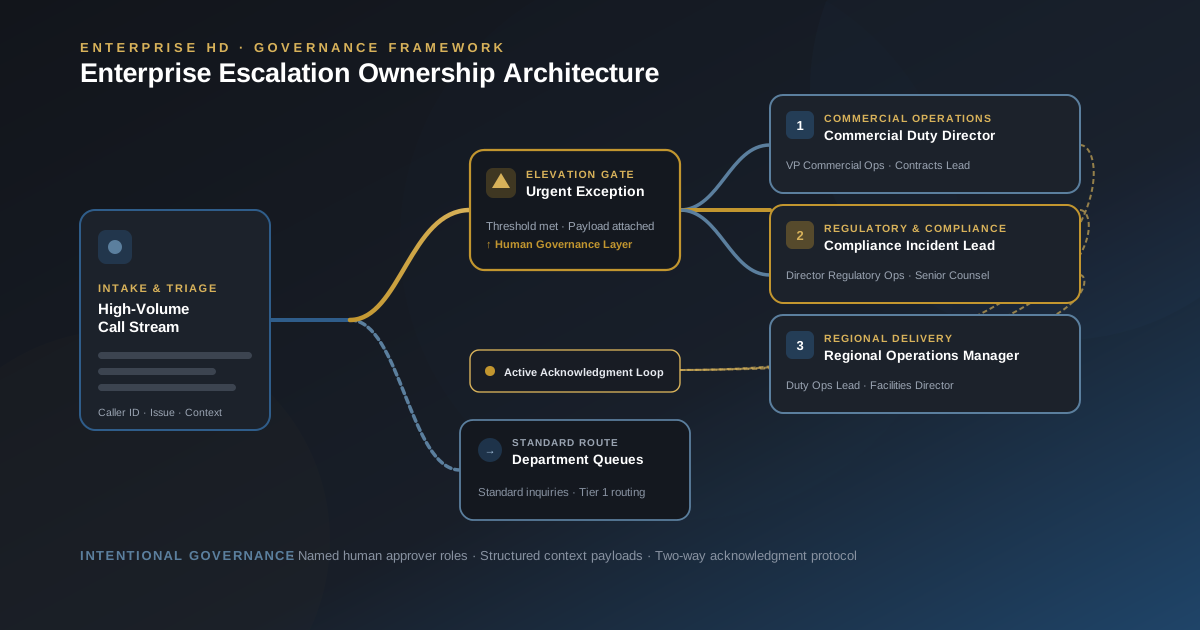
When an urgent inbound call reaches a large enterprise, the greatest point of operational failure is rarely answering the phone or identifying the caller's initial question. High-volume automated phone systems answer instantly and intake flows collect initial details reliably.
The real breakdown happens when the caller presents an urgent, non-standard exception that spans multiple corporate departments:
- A major client calls during a service disruption demanding a commercial contract waiver that frontline customer service cannot approve.
- A vendor calls regarding an urgent regulatory filing deadline, but their request touches both legal compliance and regional facilities operations.
- An enterprise account holder disputes an invoice that has triggered an automated service hold, but accounts receivable cannot release the hold without operational sign-off.
In these critical moments, automated systems cannot guess who holds authority. If the organization has not established explicit human escalation ownership across business units, the call begins a demoralizing journey: bouncing between queues, getting transferred to unmonitored shared mailboxes, or falling into voicemail limbo.
To prevent dropped handoffs and operational chaos, enterprise operations leaders must establish clear human escalation ownership across business units before the exception occurs.
A dependable escalation model requires answering four operational questions:
- What specific criteria elevate an inbound call from standard department routing to an urgent cross-department exception?
- Which designated human roles hold explicit authorization to approve exceptions within each business unit?
- What structured intake context must accompany the escalation so the caller never has to repeat their story?
- How does the organization enforce an active human acknowledgment loop to ensure the exception is never abandoned?
Here is a practical framework for defining cross-department human escalation responsibility, accompanied by a reusable operational worksheet.
1. Define objective criteria for cross-department exceptions
Not every frustrated caller or high-priority inquiry qualifies as an operational exception. If the threshold for escalation is too low, senior approvers are overwhelmed by routine inquiries that frontline teams should resolve. If the threshold is too ambiguous, staff hesitate to escalate, leaving urgent corporate risks unaddressed.
Enterprise operations leaders must define objective operational boundaries that separate standard routing from urgent human escalation:
Commercial and financial thresholds
Frontline routing should handle standard billing inquiries, payment receipts, and balance checks. Human escalation is triggered when a dispute exceeds a predetermined contractual or financial threshold:
- Disputed amounts exceeding a designated financial boundary.
- Requests for credit, penalty waivers, or contractual modifications outside standard terms.
- Enterprise accounts flagged for imminent commercial review or executive handling.
Multi-department deadlock
When a caller's issue spans two distinct business units—such as billing and technical operations, or procurement and compliance—frontline teams frequently disclaim responsibility. An escalation policy must define:
- Which business unit takes primary ownership when an issue spans multiple functions.
- The exact threshold where frontline staff must route the caller to a designated cross-functional lead rather than attempting lateral transfers.
Urgent operational and compliance flags
Certain caller statements require immediate diversion from standard queues:
- Notice of formal regulatory audit, government agency inquiry, or legal correspondence.
- Critical operational incidents affecting contracted service availability.
- Urgent security, privacy, or compliance disclosures.
As detailed in our guide on designing a policy-aware enterprise call route, routing rules must be anchored in objective operational triggers rather than vague subjective impressions.
Operational Guardrail: Establishing clear internal escalation thresholds does not constitute a certified compliance framework, automated regulatory reporting mechanism, or contractual SLA response guarantee. It is an internal organizational alignment protocol governing human responsibility.
2. Assign explicit role-based exception approvers across business units
The most common vulnerability in enterprise call escalation is assigning ownership to an unmonitored department queue, a shared email alias, or a single named individual who may be out of office.
To ensure resilience, escalation ownership must be assigned to named operational roles backed by designated primary and secondary owners within each corporate division.
+-----------------------------------------------------------------------------+
|              CROSS-DEPARTMENT HUMAN ESCALATION ARCHITECTURE                 |
+-----------------------------------------------------------------------------+
|                                                                             |
|  [ Inbound Caller ]                                                         |
|         │                                                                   |
|         ▼                                                                   |
|  [ Enterprise Intake & Triage ] ── (Standard Call) ──> [ Department Queue ] |
|         │                                                                   |
|         │ (Urgent Cross-Department Exception)                               |
|         ▼                                                                   |
|  [ Human Escalation Governance Layer ]                                      |
|         │                                                                   |
|         ├──> Commercial Operations ──> [ Commercial Duty Director ]         |
|         │                               Primary: VP Commercial Operations   |
|         │                               Secondary: Senior Contracts Manager |
|         │                                                                   |
|         ├──> Regulatory & Compliance ──> [ Compliance Incident Lead ]        |
|         │                               Primary: Director of Regulatory Ops |
|         │                               Secondary: Senior Compliance Counsel|
|         │                                                                   |
|         └──> Regional Operations   ──> [ Regional Operations Manager ]      |
|                                         Primary: Duty Operations Lead       |
|                                         Secondary: Facilities Director      |
|                                                                             |
+-----------------------------------------------------------------------------+
When structuring human escalation ownership across business units, define three key attributes for every participating department:
1. Specific decision authority
Every escalation owner must know exactly what decisions they are empowered to make on the spot. For example:
- Can the Commercial Duty Director authorize an immediate temporary service restoration pending contract review?
- Can the Compliance Incident Lead approve an expedited document release?
- If an approver lacks authority, does the policy specify an immediate executive fallback?
2. Primary and secondary coverage
Never assign an escalation path to an individual without a documented deputy. If the primary approver is engaged on another call or unavailable, the escalation system must immediately branch to a verified secondary owner.
3. Clear schedule boundaries
Different business units maintain different operating hours. If an exception arises after hours, does the call route to an on-call duty manager, or does the system capture high-priority structured intake for immediate morning dispatch? These boundaries must be explicit.
3. Transfer structured context so callers never repeat their story
Nothing erodes trust faster than an enterprise customer being escalated to a senior director, only to be asked: “So, what seems to be the problem?”
A successful human escalation depends entirely on the quality of context delivered alongside the transfer. As outlined in what an enterprise inbound intake record should include, a structured intake payload must travel with the call:
- Caller Identity & Verification: Verified caller name, corporate account name, callback phone number, and verified role/title.
- Account & Contract Reference: Enterprise account number, active contract tier, or relevant project identifier.
- Stated Issue & Impact: The caller's core reason for calling in their own words, along with their stated urgency or business impact.
- Routing & Triage History: The path the call took before escalating, including specific triage questions answered and the exact threshold that triggered the escalation.
- Requested Decision: Exactly what outcome or exception the caller is asking the approver to evaluate.
When this payload is delivered via screen pop, internal notification, or live verbal briefing, the human approver answers the phone fully prepared to lead the conversation: “Hello Mr. Davis, I understand our standard billing hold has affected your regional deployment, and you need a 48-hour authorization waiver while contract amendments are processed. Let's resolve this right now.”
4. Enforce an active human acknowledgment loop
An escalation is not complete simply because a call was transferred or a notification was dispatched. In enterprise operations, an unverified handoff is a dropped handoff.
Every human escalation path must enforce an active acknowledgment loop:
+-----------------------------------------------------------------------------+
|                     ACTIVE ACKNOWLEDGMENT PROTOCOL                          |
+-----------------------------------------------------------------------------+
|                                                                             |
|  Step 1: Automated Notification & Warm Transfer Dial                        |
|          System attempts live warm handoff to Primary Approver.              |
|                                                                             |
|  Step 2: Human Acknowledgment Check (Timeout: 45 Seconds)                   |
|          Approver must verbally accept the call or confirm receipt.         |
|                                                                             |
|          [ Did Primary Approver Acknowledge? ]                              |
|                 │                                                           |
|                 ├── YES ──> Live Warm Handoff Completed                     |
|                 │           Intake payload transferred; caller connected.   |
|                 │                                                           |
|                 └── NO  ──> Automatic Failover to Secondary Approver        |
|                             If Secondary also fails to acknowledge:         |
|                             Emergency Fallback Queue activated;             |
|                             Caller offered immediate structured callback;   |
|                             Urgent escalation ticket generated.             |
|                                                                             |
+-----------------------------------------------------------------------------+
An active acknowledgment protocol prevents the three most common points of failure:
- The Dead Transfer: A caller transferred to a desk phone that rings indefinitely until the carrier disconnects.
- The Black-Hole Voicemail: A caller dumped into a generic voicemail box that is only checked once daily.
- The Unassigned Queue: A ticket dropped into a general dispatch bucket with no named individual responsible for opening it.
If neither the primary nor secondary approver acknowledges the escalation within the configured window, the system must trigger an intentional fallback: informing the caller transparently of the immediate next step, logging an urgent priority ticket, and dispatching an immediate escalation notification to the department head.
5. Enterprise Escalation Ownership Worksheet
To help enterprise operations leaders map escalation responsibilities across their organization, use the following operational worksheet. This blank template provides a structured foundation for auditing cross-department handoffs, assigning role-based approvers, and documenting exception protocols.
+======================================================================================================================+
|                                  ENTERPRISE ESCALATION OWNERSHIP WORKSHEET                                           |
|                                     (Operational Alignment Planning Tool)                                            |
+======================================================================================================================+
| Organization / Division: _____________________________________   Date: ___________________________________________  |
| Operations Review Lead: ______________________________________   Review Cycle: [ ] Initial Setup  [ ] Periodic Audit  |
+----------------------------------------------------------------------------------------------------------------------+
|                                                                                                                      |
| SECTION 1: BUSINESS UNIT & ESCALATION SCOPE                                                                          |
| 1.1 Business Unit / Department Name: _______________________________________________________________________________ |
| 1.2 Core Inbound Functions Handled: _________________________________________________________________________________ |
| 1.3 Operating Hours & Time Zones: __________________________________________________________________________________ |
|                                                                                                                      |
+----------------------------------------------------------------------------------------------------------------------+
| SECTION 2: EXCEPTION TRIGGERS & ELEVATION THRESHOLDS                                                                 |
| 2.1 Commercial / Financial Threshold: (e.g., disputed amount > $25k; custom contract waiver request)                  |
|     ________________________________________________________________________________________________________________ |
| 2.2 Operational Severity Trigger: (e.g., enterprise outage; regional facility halt; multi-unit deadlock)            |
|     ________________________________________________________________________________________________________________ |
| 2.3 Regulatory / Compliance Trigger: (e.g., legal notice; formal audit request; executive inquiry)                     |
|     ________________________________________________________________________________________________________________ |
|                                                                                                                      |
+----------------------------------------------------------------------------------------------------------------------+
| SECTION 3: DESIGNATED HUMAN APPROVER ROLES                                                                           |
| 3.1 Primary Escalation Approver:                                                                                     |
|     - Designated Role Title: _______________________________________________________________________________________ |
|     - Named Incumbent(s): __________________________________________________________________________________________ |
|     - Direct Transfer Destination / Extension: _____________________________________________________________________ |
|     - Specific Decision Authority: _________________________________________________________________________________ |
|                                                                                                                      |
| 3.2 Secondary (Deputy) Approver:                                                                                     |
|     - Designated Role Title: _______________________________________________________________________________________ |
|     - Named Incumbent(s): __________________________________________________________________________________________ |
|     - Direct Transfer Destination / Extension: _____________________________________________________________________ |
|     - Failover Trigger: (e.g., primary unreachable after 45 seconds / 3 rings) ______________________________________ |
|                                                                                                                      |
+----------------------------------------------------------------------------------------------------------------------+
| SECTION 4: CONTEXT PAYLOAD & INTAKE PREREQUISITES                                                                    |
| [ ] Caller Identity (Full Name, Direct Callback, Verified Corporate Email)                                           |
| [ ] Account Identifier (Enterprise Account #, Master Agreement ID, Active Contract Tier)                             |
| [ ] Stated Problem & Desired Outcome (Caller's exact words, business impact)                                         |
| [ ] Triage Path History (Originating queue, questions answered, specific threshold breached)                          |
| [ ] Additional Prerequisite Fields Required by Receiving Unit: _____________________________________________________ |
|                                                                                                                      |
+----------------------------------------------------------------------------------------------------------------------+
| SECTION 5: ACKNOWLEDGMENT PROTOCOL & FALLBACK PATH                                                                   |
| 5.1 Live Handoff Protocol: [ ] Warm Transfer with Verbal Briefing   [ ] Screen Pop with Instant Acceptance           |
| 5.2 Acknowledgment Timeout Window: [ ] 30 Seconds   [ ] 45 Seconds   [ ] 60 Seconds                                  |
| 5.3 Failover Path (if Primary & Secondary unacknowledged):                                                           |
|     - Fallback Action: [ ] On-Call Duty Lead   [ ] Executive Dispatch Queue   [ ] Priority Structured Callback       |
|     - Caller Communication Script: _________________________________________________________________________________ |
|     - Internal Escalation Alert Destination: _______________________________________________________________________ |
|                                                                                                                      |
+----------------------------------------------------------------------------------------------------------------------+
| SECTION 6: APPROVAL SIGN-OFF & OPERATIONAL ACCEPTANCE                                                                |
| Relieving Operations Lead: ____________________________ Signature: _______________________ Date: ___________________ |
| Receiving Department Head: ____________________________ Signature: _______________________ Date: ___________________ |
| Escalation Approver Lead: _____________________________ Signature: _______________________ Date: ___________________ |
+======================================================================================================================+
Planning Guidance: Complete one worksheet for each distinct corporate business unit that handles inbound exceptions. Review and re-validate these worksheets whenever department leadership, commercial contracts, or operating policies change, following the procedures outlined in our call route change review guide.
6. Illustrative Scenario: Cross-Department Commercial & Compliance Exception
To illustrate how these principles operate in a live enterprise environment, consider the following representative scenario.
(Note: The following scenario is entirely Illustrative and is provided for operational planning purposes. It does not represent an actual customer transcript, live system telemetry, or verified client outcome.)
The incoming exception
At 2:15 PM, an inbound call arrives on the main enterprise line from the Chief Technology Officer of a major enterprise account. The caller is agitated:
- Their automated nightly data sync failed due to an administrative suspension triggered by an overdue supplemental invoice.
- The customer's legal team has placed the invoice on hold pending an addendum regarding new regional data privacy disclosures.
- The customer's core operations are impacted, and the CTO requires an immediate waiver to restore system access while the legal teams finalize the addendum.
Why standard routing fails
Under standard call routing:
- If routed to Accounts Receivable, the billing agent states company policy: accounts with unpaid balances over 30 days cannot be reactivated without full payment.
- If transferred to Technical Support, the helpdesk confirms the suspension is administrative and transfers the caller back to billing.
- If transferred to Legal / Compliance, the call reaches a voicemail box for contract review.
The customer is caught in an enterprise deadlock between three separate departments, with no individual taking responsibility.
Resolution under defined escalation ownership
Because the enterprise operations team completed an Escalation Ownership Worksheet, the inbound AI phone agent follows a governed escalation policy:
- Intake & Triage Evaluation: The phone agent identifies the caller, validates their executive role on the enterprise account, captures the urgent operational suspension issue, and identifies that the inquiry involves both an invoice dispute over the $25,000 threshold and an active compliance addendum.
- Exception Threshold Match: The system recognizes this as a designated Category 1 Commercial & Compliance Deadlock, bypassing standard frontline billing queues.
- Targeted Role Routing: Per Section 3 of the worksheet, the route targets the Commercial Duty Director (Primary Approver), with automatic failover to the Director of Legal Operations (Secondary Approver).
- Structured Context Delivery: As the call connects, the phone agent delivers the structured context payload: account ID, overdue invoice reference, active contract addendum ticket number, and the CTO's explicit request for a temporary 48-hour administrative waiver.
- Active Human Acknowledgment: The Commercial Duty Director acknowledges the call within 25 seconds, reviews the structured context on screen, and accepts the warm handoff.
- Decisive Resolution: Armed with pre-authorized decision authority, the Commercial Duty Director greets the CTO, acknowledges the pending privacy addendum, immediately grants a temporary 48-hour access waiver, and schedules an internal 3:00 PM briefing with legal counsel to resolve the invoice addendum.
The entire escalation took less than two minutes, the caller never repeated their problem, and the organization resolved a critical customer crisis through clear human accountability.
7. Scaling Dependable Call Handling with Enterprise HD
Achieving consistent, policy-aware call handling across large organizations does not require rigid, unmaintainable legacy infrastructure or risky point solutions. It requires pairing high-volume phone automation with clear human governance that your operations leaders control.
Enterprise HD provides an enterprise-grade inbound AI phone agent built specifically for large, multi-department organizations:
- 24/7 High-Volume Call Answering: Answers every incoming call across multiple lines and divisions, eliminating busy signals and dropped calls.
- Governed Identification & Intake: Executes your approved caller qualification and intake criteria with unwavering consistency.
- Intelligent Department Routing: Directs callers across teams, queues, and regional divisions according to your operational rules.
- Intentional Human Escalation: Connects urgent exceptions and high-priority callers to designated human leads and on-call queues with complete context.
- Operational Control: Allows operations teams to update call flows, intake questions, and routing paths as business needs evolve.
Transparent Enterprise Phone Service Terms
Enterprise HD operates under straightforward, transparent terms set out in our Terms of Service and How It Works:
- Monthly Base Subscription: $299 per month, billed month to month.
- No Setup or Onboarding Fees: $0 setup fee.
- Included Monthly Usage Allowances: 500 inbound voice minutes and 500 SMS text messages per monthly billing period.
- Metered Overage Rates: Usage exceeding monthly allowances is billed at $0.20 per additional minute and $0.04 per additional SMS (standard month-to-month terms; note: standard portfolio tier pricing applies).
- Sales-Assisted Setup: A sales specialist assists in establishing your initial call flows and routing paths. Subsequent changes are easily made directly in the platform, with support available for additional assistance.
- Month-to-Month Flexibility: Cancel prior to your next billing cycle to prevent renewal. Phone service remains active through the paid period; incurred overages remain due. Refunds for prepaid monthly service are considered case by case.
To establish clear escalation ownership across your corporate business units, explore How It Works, review our FAQ, or request an Enterprise HD briefing.