One Stop Request Must Reach Every Outreach Owner
Trace a stop request through departments, vendor exports, and pending outreach, with named owners and a concrete verification example.
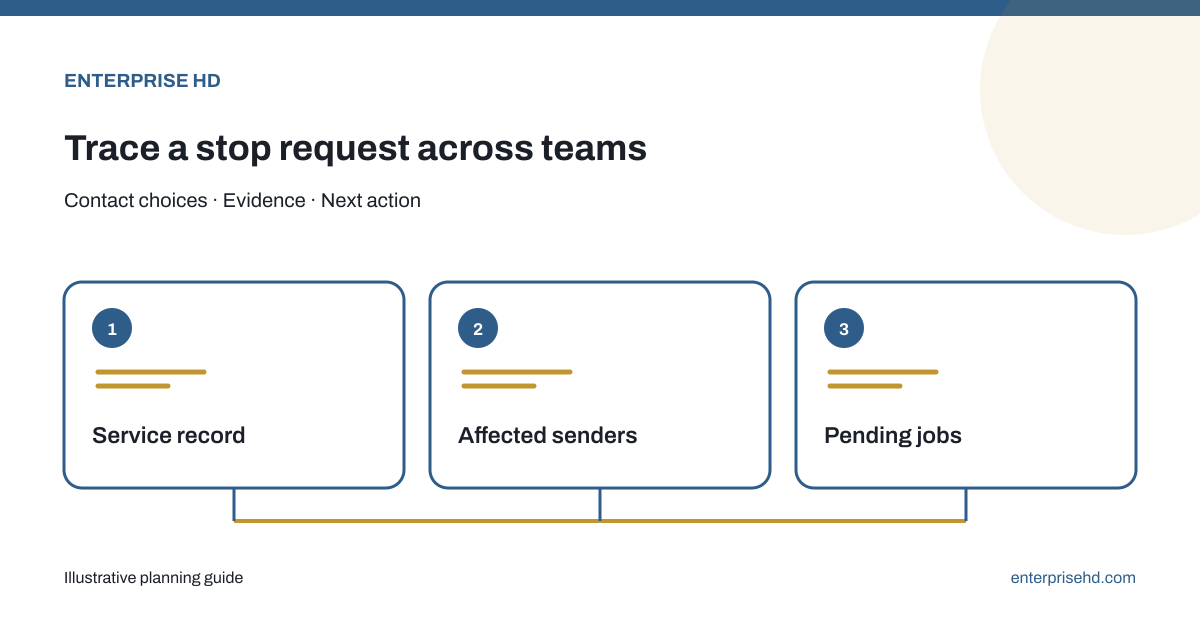
Large organizations may have separate teams for intake, service, sales, and campaigns. A request to stop marketing should not disappear because it was heard on a service line. The governance question is simple: who records the request, who receives it, and who verifies it before another outreach attempt?
Trace the request across systems and people
Map every point where a person might say “stop calling” or “stop texting”: live agent, voicemail review, reply text, form, and vendor. Record the receiving team, the system of record, and the people who can update suppression. A department-only note is weak if another sender never sees it.
Test the handoff with a synthetic request
Use a synthetic contact record in an isolated test environment with external delivery disabled and trace a stop request from entry to every relevant outbound list. Note any queue, export, or vendor handoff that can reintroduce the number. Decide who owns exceptions and how the team will verify a correction before the next campaign.
Work through one case
Illustrative: A customer asks service to stop promotional calls from the business. The service record changes, but a vendor has already exported tomorrow’s call list. Test whether the restriction reaches that export and its pending jobs. Record who checked the vendor result; changing the central record alone does not demonstrate that the queued outreach stopped.
Define which seller, channels, and purposes the request covers. A restriction must reach every team acting within that scope; do not describe every objection as automatically canceling unrelated informational notices.
Apply the questions to this example
Illustrative worked example: These sample notes extend the case above. Roles and record locations are proposed for the example, not descriptions of a customer or this brand’s configured service. Adapt them to your own process.
| Step | Question | Sample evidence, owner, and next action |
|---|---|---|
| 1 | Which channels can receive an objection? | Service call: customer asks to stop promotional calls; service owner records the wording and affected business. |
| 2 | Which teams and vendors send on our behalf? | Campaign team and its calling vendor: identify tomorrow’s exported list and pending jobs covered by the request. |
| 3 | Who confirms suppression after a change? | Campaign operations owner: obtain vendor confirmation and check the pending jobs before treating propagation as complete. |
Put the next step in writing
Fold this control into the route-change review. It is a governance worksheet, not a claim that a particular platform or certification supplies the control.
This control review helps expose gaps between departments and vendors. It is not a legal determination of revocation scope; confirm that scope against the actual sender, message program, and applicable requirements.
Further reading: FCC call and text guidance · FTC telemarketing resources.
Contact Enterprise HD to discuss the inbound workflow described on this site.